
Flowing non-Newtonian fluids
Finding the right instrument to measure or control non-Newtonian fluids can be a challenge. Some popular flow technologies like electromagnetic meters can exhibit up to a 20% deviation in accuracy when used for such fluids. Ultrasonic flow meters have also shown up to 15% deviation when used for non-Newtonian fluids transitioning between laminar and turbulent flow. In this blog, we will discuss the challenges posed by non-Newtonian fluids and how Coriolis flow instruments have proven to be the most successful solution.
What are non-Newtonian fluids
Newtonian fluids—for example, water—exhibit a constant viscosity regardless of any applied force. Non-Newtonian fluids, on the other hand, change in viscosity depending on the type and magnitude of forces exerted upon them.
| Newtonian fluids | Non-Newtonian fluids |
| Water | Diesel exhaust fluid |
| Alcohol | Blood |
| Glycerol | Soap solutions |
| Gasoline | Honey |
The effect of shear stress
For any process fluid moving through a pipe, shear forces are caused by the molecules inside the fluid moving past each other. For Newtonian fluids, these shear forces do not lead to a change in viscosity, and the flows have predictable velocity profiles.
In the diagram below, you can see that when Newtonian fluids flow through a pipe, increased shear stress near the pipe walls causes a decrease in velocity. This leads to a faster fluid flow at the center of the pipe, and a slower fluid flow at the pipe walls. The resulting velocity profile is then predictable as a function of the shear stress.
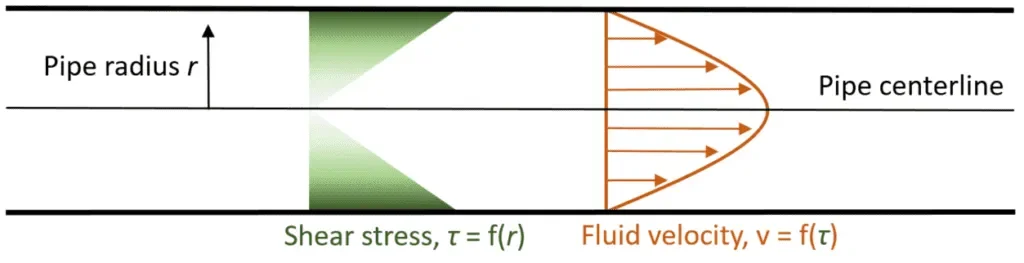
Figure 1. Newtonian flow through a pipe
In contrast, the velocity profiles are not as predictable for non-Newtonian fluids, because the shear stress affects not only the velocity, but also the viscosity of the fluid. When the viscosity of the fluid changes as a function of this stress, the velocity profile through the pipe can be rendered asymmetrical, changing, and unpredictable.
How does shear stress affect viscosity for non-Newtonian fluids?
Non-Newtonian fluids can be classified into one of four groupings, characterized by the effect shear stresses have on their viscosities.
- Dilitant (shear thickening) fluid viscosity increases with shear stress
- Pseudoplastic (shear thinning) fluid viscosity decreases with shear stress
- Thixotropic fluid viscosity increases with shear stress over time
- Rheopectic fluid viscosity decreases with shear stress over time

