
Flow Control for Fluxless (Formic Acid) Soldering and Die Bonding

Fluxless soldering and die bonding with formic acid
Fluxless oxide-reduction soldering and die bonding replace chemical flux with a reducing atmosphere, so the joint forms clean and there is no post-bond flux residue to remove. In advanced packaging, the fastest-growing back-end segment, the reducing agent is most often formic acid vapor carried in nitrogen, with forming gas (hydrogen in nitrogen) as the alternative route. At bonding temperature, formic acid reduces copper and tin oxides to bare metal plus carbon dioxide and water, and the mechanism runs in two steps: formate forms on the oxide roughly between 150 °C and 200 °C, then decomposes above that to leave a wettable surface. The result is oxide-free, void-minimized, residue-free joints.
Two process families sit in scope, and both put the same demand on the reducing-gas stream: formic acid reflow soldering (solder bumps, die attach, power devices) and fluxless thermocompression and hybrid bonding (fine-pitch, copper-to-copper, chiplets, and high-bandwidth memory). What makes flow control here different from metering an inert gas is that the reagent cannot be measured accurately where it is used. The reducing dose has to be established without measuring the vapor, then carried to the chamber without loss.
Challenge
Formic acid cannot be metered like an inert gas
The reducing power is set by concentration, and concentration is a process variable in exactly the way soak temperature is: fluxless processes run the nitrogen carrier at a few percent formic acid vapor, with the patent literature describing a band of about 3 to 15 percent. Formic acid dominates advanced packaging for a thermal reason: hydrogen in nitrogen reduces copper and nickel oxides effectively only at 350 °C and above, while tin-based alloys reflow well below that, so forming gas is right for gold-tin and high-lead die attach and wrong for most of the back end.
Getting that concentration wrong is costly in either direction. Under-dose, and residual oxide leaves incomplete wetting and a higher void fraction under X-ray or acoustic microscopy; a good atmosphere holds voiding under 1 percent on direct bonded copper. Over-dose, and the excess produces tin steaming, a fog of redeposited tin and tin-oxide particles that settles on the surfaces around the joint. Neither failure shows up at the tool; it surfaces later as a shifted void population across a whole lot, after the die is attached, when the only options left are scrap or rework.
What makes it hard is that the concentration cannot be read where it is used. Formic acid vapor associates into hydrogen-bonded dimers, and the monomer-to-dimer split shifts with temperature and partial pressure, so the mixture’s effective molar mass, viscosity and thermal conductivity all move with the operating point, and it is not represented in the standard gas-property data that flow instruments rely on. Any instrument that infers flow from those properties, a laminar differential pressure meter or a thermal mass flow controller, reads the combined stream against a surrogate gas and carries a systematic, concentration-dependent offset. A Coriolis meter is the exception, because it measures mass directly and needs no gas model, but at the dilute, near-atmospheric density of a reducing-gas stream a gas-phase Coriolis measurement is impractical. So no instrument in the vapor returns an absolute concentration, and the dose has to be established another way.
Delivery is a materials problem as much as a thermal one. Formic acid attacks brass, aluminum and fluoroelastomers such as FKM, so the wetted path is stainless steel with an elastomer chosen for the service. The vapor condenses anywhere the path falls below the mixture’s dew point, which puts the whole atmospheric-side run inside a heated zone, instruments included. A controller sitting at room ambient in a 75 °C line is a dense metal body with a large surface area, and it cools below the rest of the line.
The coldest point in the delivery path, not the average, sets what reaches the chamber. Verify temperature at the instrument body and its fittings rather than at the line heater’s setpoint, and hold it above the vapor’s dew point with margin. Fittings and instrument bodies are where the heat tracing stops and the thermal mass starts.
Options
Where the concentration gets fixed
Once formic acid is the reagent, the architectural decision is where the concentration gets fixed: thermodynamically, by saturating a carrier over the liquid, or gravimetrically, by metering the liquid and the carrier independently and letting their ratio define it.
| Architecture | Where the dose is fixed | What limits run-to-run repeatability | When to pick it |
|---|---|---|---|
| Sparged carrier: nitrogen saturated over liquid formic acid, mass flow control on the combined stream | In the acid pot. Concentration follows the liquid’s saturation pressure at pot temperature; the controller sets total stream flow only. | Pot temperature control and sparge efficiency, both upstream of the measurement and invisible to it. | Concentration is fixed and already validated by joint quality, and the pot is well controlled. Simplest reagent handling: no liquid line, no pump, no vaporizer, and one instrument instead of two. |
| Metered: independent liquid and carrier mass metering into a vaporizer | In the ratio of two independently measured mass flows. No saturation step sits in the chain, so no pot temperature for the dose to follow. | The two mass measurements, and whether the vaporizer takes the liquid fully into the gas phase. | Concentration is itself a recipe variable, or the concentration window has tightened and the atmosphere has to be defensible in a process record. Costs a vaporizer, a liquid line and a reservoir to maintain. |
The sparged route fits a concentration that is fixed and validated by joint quality; the metered route fits one that has to be set or defended as a number.
Selection
Instrumenting the two delivery routes
Both routes are built from Alicat controllers, and differ mainly in how many instruments there are and where they sit.
The sparged route: one controller on the mixed stream
The sparged route is the simplest way to deliver the reducing gas, and on a fixed recipe it is frequently the right one. Nitrogen is bubbled through a temperature-controlled pot of formic acid, and a single corrosion-resistant MCS on the combined stream holds the total reducing-gas flow to the tool. There is no liquid line, no pump, and no vaporizer to maintain: one controller does the whole job.
Its repeatability is won or lost at the pot, not at the meter, because the concentration follows the pot temperature. At a 25 °C pot, the NIST Chemistry WebBook Antoine fit for formic acid puts the vapor at 57 mbar, about 5.6 mol percent of an atmospheric stream, and near there the concentration moves about 4.7 percent for every degree. So a ±1 °C wander is a ±4.7 percent swing in delivered reagent, while the MCS on the combined stream holds flow to about ±0.4 percent and reads rock-steady the whole time. The pot temperature is the bigger term by roughly twelve to one, and it is the one the flow reading is blind to; that is even the optimistic case, since it assumes the sparge saturates fully when real sparge efficiency falls short and drifts with liquid level and carrier rate.
None of that disqualifies the route when the recipe is fixed and validated by joint quality: the drift is real but sits inside the process window, and the MCS on the wet stream delivers repeatable flow rather than an absolute concentration, reading against a surrogate gas. Size the full scale to the maximum delivery flow rather than to an occasional purge, so it reaches the high end while the low-flow setpoints stay controllable; specify the corrosion-resistant build with high-temperature electronics for the heated line; and the result is a robust, low-maintenance delivery.
The metered route: two mass flows into a vaporizer
Moving the metrology onto the liquid puts the reagent on a Coriolis instrument, which measures mass directly and needs no fluid-property model at all. Moving the carrier onto a laminar differential pressure gas controller puts the nitrogen on a gas that does have a traceable model, evaluated against the instrument’s own measured pressure and temperature. Concentration then falls out of two numbers the tool already has. The acid pot temperature that governed dose repeatability in the sparged case is not compensated for; it is absent from the chain, because there is no saturation step for the dose to follow. Temperature still has to be managed, the vaporizer has to stay hot enough to flash the liquid fully and the path hot enough to keep the vapor above its dew point, but it becomes a threshold to clear with margin rather than a setpoint the concentration follows degree by degree.
What remains as an error source is the pair of mass measurements and the vaporizer’s ability to take the liquid fully into the gas phase, and both are observable. The liquid controller reports its own mass flow and fluid temperature; the carrier controller reports absolute pressure and gas temperature at its body, where a cold spot would show up first.
Because the concentration is the ratio of two mass flows, its uncertainty is the two instrument terms combined: near mid-range, about 0.8% of reading on the carrier and 0.6% on the liquid, which combine to roughly 1.0% of reading on the delivered concentration. Sizing the carrier to its real operating point does more for that figure than moving up an accuracy class.
One term is not in that budget and cannot be taken from published specifications: whether the vaporizer takes the entire metered liquid into the gas phase at the flow, inlet temperature and pressure the line actually runs. Incomplete vaporization biases delivered concentration low without appearing in either instrument’s reading, so it belongs to the vaporizer vendor and to commissioning data. The metered route also costs a liquid line, a reservoir and that vaporizer, which is tool-supplied rather than ours, and it is worth that hardware where the concentration has to be set or defended as a number.
The concentration has to move within a run. A bubbler holds one concentration per pot temperature and cannot step or ramp it quickly. Where the recipe changes the reducing dose on the fly, or needs it logged as a traceable number, meter the liquid and carrier so the ratio moves on command.
Enclosure ambient above 60 °C at the liquid instrument. The Coriolis is rated to 60 °C ambient, well below the 85 °C a high-temperature-electronics gas instrument tolerates. If the reagent line cannot be routed to a cooler zone or given a thermal break, the metered route cannot be built and the sparged one, with only a gas-side instrument, is the answer.
Peak process temperature at or above 350 °C. Hydrogen becomes an effective reductant there, and a forming gas atmosphere removes the condensable and the corrosive from the problem entirely. Gold-tin and high-lead die attach usually belong on that route, and its flow control is a straightforward gas application.
Nothing electronic can be kept alive at the metering point. A needle valve and a variable-area meter on a sparged stream still work. They indicate volumetric flow at reference conditions and offer no setpoint or log, but on a fixed recipe with a wide process window that is often enough.
A cleanliness or high-purity qualification on the instrument. A corrosion-resistant Alicat build is a materials-compatibility build, with no cleanroom processing, surface-finish specification or high-purity qualification. A reagent line feeding a gas panel held to a purity standard needs instruments qualified to that standard.
| Family-level capability | What it does in a formic acid delivery module |
|---|---|
| 316L / 303 / 430FR stainless steel flow path, FFKM seals standard, with FKM or EPDM where a gas requires it (EPDM for formic acid) | Keeps the wetted path out of the materials formic acid attacks: brass, aluminum and FKM. |
| High-temperature electronics option: gas to 100 °C and ambient to 85 °C, with a remote display or none | Lets the gas instrument sit inside the heated enclosure rather than become the coldest point in a hot path. |
| MCS-Series gas mass measurement: ±0.4% of reading and 0.2% of full scale, with 128 preloaded calibrations including corrosive gases | Meters the nitrogen accurately against a traceable gas model. |
| Coriolis liquid mass measurement: ±0.6% of reading standard, ±0.2% of reading high-accuracy, ±0.1% of full scale repeatability | On the metered route, sets the reagent term by true mass, independent of the liquid’s density, viscosity, pressure and temperature; no surrogate calibration is involved. |
| Simultaneous mass flow, volumetric flow, absolute pressure and gas temperature | Pressure and temperature read at the instrument body are the signals that say whether the heated path is doing its job. |
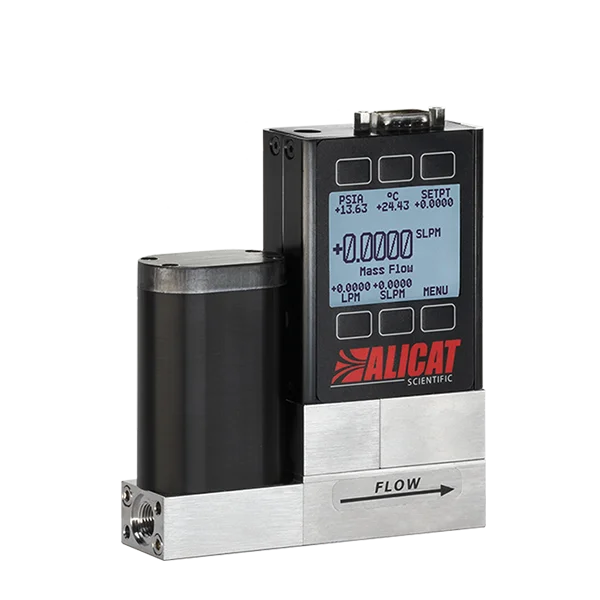
MCS-Series Mass Flow Controllers
Nitrogen carrier line, and combined-stream duty on sparged builds
A laminar differential pressure gas controller with a reduced wetted-material set for aggressive service, translating from its air calibration to the selected gas through NIST-traceable property data evaluated against its own measured pressure and temperature.
- 316L / 303 / 430FR stainless steel flow path, FFKM seals standard, with FKM or EPDM where a gas requires it (EPDM for formic acid)
- 128 preloaded gas calibrations (Gas Select), including corrosive gases; change the active gas without recalibration
- Accuracy as good as ±0.4% of reading and 0.2% of full scale, NIST-traceable
- Control response as fast as 30 ms
- High-temperature electronics option for gas to 100 °C and ambient to 85 °C, with a remote display or none
- Metal face-seal (VCR) among the available process connections; analog, serial (RS-232 or RS-485, running Alicat’s native ASCII protocol or Modbus RTU), and industrial network options such as EtherCAT and EtherNet/IP
- Made to order, with current lead time confirmed at quote
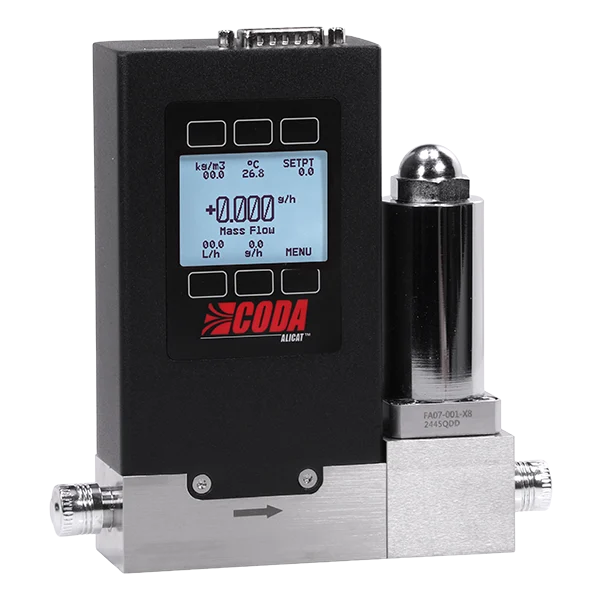
CODA-Series Liquid Controllers
Neat formic acid into a direct liquid injection vaporizer
A miniaturized Coriolis controller that measures liquid mass flow directly, so no property model sits between the reagent and the number, and the delivered vapor concentration becomes defensible without ever measuring the vapor.
- Full-scale ranges from 40 g/h to 300 kg/h, spanning the hundreds-of-grams-per-hour band typical of reagent injection
- Accuracy as good as ±0.6% of reading standard, or ±0.2% of reading in the high-accuracy variant
- Flow repeatability ±0.1% of full scale standard; ±0.05% of reading (or ±0.025% of full scale) in the high-accuracy variant
- Control response as good as 140 ms
- 316L stainless steel and PCTFE wetted materials, with a nickel-alloy option for the neat-liquid formic duty; metal face-seal (VCRM) among the process connections
- Fluid temperature −35 °C to 70 °C; ambient temperature 0 °C to 60 °C, which sets where in the enclosure the instrument can be mounted
Related families: the MC-Series where the wetted-material constraint does not reach the carrier leg, and the same MC-Series or MCS-Series hardware for a forming gas recipe with the active gas changed. Where the pressure budget between a tens-of-PSIG inlet and a near-atmospheric outlet is tight, low-pressure-drop configurations are available. Talk to an engineer to confirm fit and select a configuration.
Configure the right MCS-Series and CODA-Series pair for your fluxless line.
Send the reagent concentration band, the carrier flow range including its low end, the neat liquid rate in grams per hour, the enclosure ambient at each instrument location, and the tool’s process connection standard. What comes back is a family and full-scale recommendation, a wetted-materials disclosure for your service, a build that fits the heated zone, and current lead time.
Outcomes
Matching the route to the line
Which route fits depends on the line. A fixed recipe, already validated by joint quality, is well served by the sparged route: one instrument, no vaporizer, and repeatable flow with the concentration held by a well-controlled pot. A recipe where concentration is itself a variable, or where the concentration window has tightened and the atmosphere has to be defensible in a process record, is better served by the metered route, where the concentration is the ratio of two measured mass flows and no pot temperature sits in the chain.
Either way it is the same instrument family and one supplier: a corrosion-resistant MCS on the carrier or the combined stream, and, where the liquid has to be metered, a Coriolis CODA feeding the vaporizer. The MCS also runs a hydrogen forming-gas blend with no new hardware, for the higher-temperature alloys that belong on that route.
Value gained
- Repeatable dosing – stable, run-to-run reducing dose with clean control into the sub-1-SLPM range, which is what the bond process needs.
- True-mass accuracy – a Coriolis controller meters neat formic acid by mass, so the delivered vapor concentration is defensible without ever measuring the vapor.
- Corrosion-compatible build – a 316L flow path with elastomers selected for formic acid service, disclosed as actual wetted materials rather than an idealized flow path.
- Built for the heated zone – high-temperature-rated electronics operate inside the heated delivery enclosure instead of becoming its cold spot.
- Two routes, one supplier – formic acid vapor and forming gas run on the same instrument family, with a corrosion-resistant gas controller and a Coriolis liquid controller feeding a vaporizer.
Field deployment notes
Engineering considerations
- The instrument is usually the cold spot
- Heat tracing follows tubing well and follows valve bodies, fittings and instrument cases poorly. In a delivery path held at around 75 °C, an instrument at room ambient will condense reagent on its wetted surfaces, which both removes formic acid from the stream and puts liquid acid on the flow element. Specify the high-temperature electronics option and put the instrument inside the heated enclosure, then verify body temperature there rather than trusting the line heater setpoint.
- Size the full scale to the delivery band, not to a purge
- The full scale has to cover the maximum reagent-delivery flow, but no more than that. Corrosion-resistant laminar differential pressure controllers control from 1 percent of full scale, so a 20 SLPM device controls down to 0.2 SLPM and a 0.5 SLPM setpoint sits at 2.5 percent of full scale, inside the band with margin. That margin disappears quickly if the full scale is chosen for the highest purge rate the tool ever runs, which pushes the dosing setpoints toward the bottom of the range. Size the full scale to the top of the reagent-delivery band and keep a high-rate purge on a separate path.
- Where the Coriolis can physically live
- Coriolis liquid controllers carry a 60 °C ambient ceiling, though the fluid itself can run to 70 °C, because the drive and pickoff electronics sit on the sensor assembly. In a module where the vaporizer and the delivery run are both hot, the liquid instrument goes upstream of the heated zone, on the cool side of a thermal break. This is a layout decision, not a configuration option, and it is worth settling before the enclosure is drawn.
- Elastomer selection is a disclosure, not a certification
- FFKM is the standard seal on the corrosion-resistant gas family, with FKM or EPDM specified where a particular service calls for it; formic acid is a case where fluoroelastomers are commonly ruled out and EPDM is chosen instead. Alicat states the actual wetted materials of a given build. That is materials compatibility information for the engineer to assess against their own chemistry, not a qualification to a purity or cleanliness standard.
- Stainless steel resistance is concentration- and temperature-dependent
- The corrosion-resistant gas controller’s wetted metals are stainless, chiefly 316L with some 303 and 430FR, and for a dilute vapor stream 316L is well suited: published testing found only slight corrosion, with no measurable weight loss, on 316L held in 0.5 to 15 percent formic acid at 90 °C for 1200 hours. The more aggressive environment is the neat liquid, not the vapor: concentrated formic acid, higher temperature, and any halide contamination push stainless from passive toward active corrosion. Match the wetted metals to what each instrument actually sees, disclosed per build, and where the neat-liquid duty is demanding, a nickel-alloy wetted option is available on the Coriolis liquid controller.
- What to record about a vapor-stream reading
- Any flow number taken in the combined formic acid and nitrogen stream is referenced to a surrogate gas and carries a systematic, concentration-dependent offset. Record it in the process file as a repeatability index tied to one concentration setpoint, not as an absolute concentration, and re-establish the reference whenever the recipe concentration changes. A surrogate-referenced number treated as absolute loses traceability between recipe revisions.
- Specify shutoff performance, do not assume it
- When the controller is commanded closed, any leak-by keeps passing reagent into the chamber, which wastes formic acid and destabilizes the reducing atmosphere between cycles. Both the gas and liquid controllers use a normally-closed valve, but leak-by when closed is not a published specification. If the process depends on tight shutoff at low flow, state it in the requirements and confirm it for the specific configuration rather than assuming it.
Frequently asked questions
Can a mass flow controller measure formic acid vapor accurately?
A thermal or laminar differential pressure controller does not measure formic acid vapor to a traceable absolute standard. The acid associates into hydrogen-bonded dimers whose fraction shifts with temperature and partial pressure, and it is not represented in the standard gas-property data those instruments rely on, so an instrument placed in the vapor stream is referenced to a surrogate gas and delivers repeatability rather than absolute accuracy. A Coriolis meter needs no gas model, but a gas-phase Coriolis measurement is impractical at the dilute, near-atmospheric density of this stream. The reliable way to a defensible absolute number is to meter the neat liquid by true mass and the carrier gas separately, then set concentration by their ratio.
What concentration of formic acid is used in fluxless soldering?
Published fluxless processes run the nitrogen carrier at a few percent formic acid vapor, with the patent literature describing a band of about 3 to 15 percent. The right number for a given line is set by the oxide load, the soak time and the alloy, not by a universal figure. Excess concentration or exposure carries its own defect risk, so the band is bounded on both sides.
Do you need a heated mass flow controller for formic acid?
You need an instrument rated to operate inside a heated zone, which is not the same as a heated instrument. Alicat’s high-temperature electronics option is rated for gas to 100 °C and ambient to 85 °C, and all of that heat comes from the line and enclosure the tool builder supplies. Integrated displays are not compatible with the high-temperature option, so those builds use a remote display or no display.
Is forming gas or formic acid better for fluxless soldering?
Forming gas is the better choice when the process peaks at or above 350 °C, which is where hydrogen becomes an effective reductant on copper and nickel oxides; formic acid is the better choice below that, which covers the tin-based alloys that reflow well under it. The tradeoff is chemistry and thermal budget, not equipment quality. Forming gas also avoids a condensable and a corrosive entirely, at the cost of hydrogen area classification.
What wetted materials are compatible with formic acid vapor?
Formic acid attacks brass, aluminum and fluoroelastomers such as FKM, so a delivery path is normally built in 316L stainless steel with an elastomer selected for the service, and EPDM is the common choice where FKM is ruled out. Metal face-seal fittings keep the joints leak-tight through thermal cycling. Confirm the specific elastomer against your reagent concentration and operating temperature rather than assuming a single answer covers every build.