Avoiding jetting in mass flow controllers: the vena contracta
High flow mass flow controllers always need downstream valves and high flow meters can’t be plumbed with small process ports.
The reason for this is jetting. But what is jetting? What causes it? Why is it important for Alicat devices in particular and why is it mainly an issue in high flow devices?
To answer these questions, we need to first discuss what is happening as fluids pass through our valves.
Categorizing flow through flow restrictions
In unrestricted laminar flow, fluid moves in a consistent and organized way. The flow channels run parallel in the direction of flow, such as in non-turbulent river and plumbing systems. The flow pattern is regular and easy to categorize.
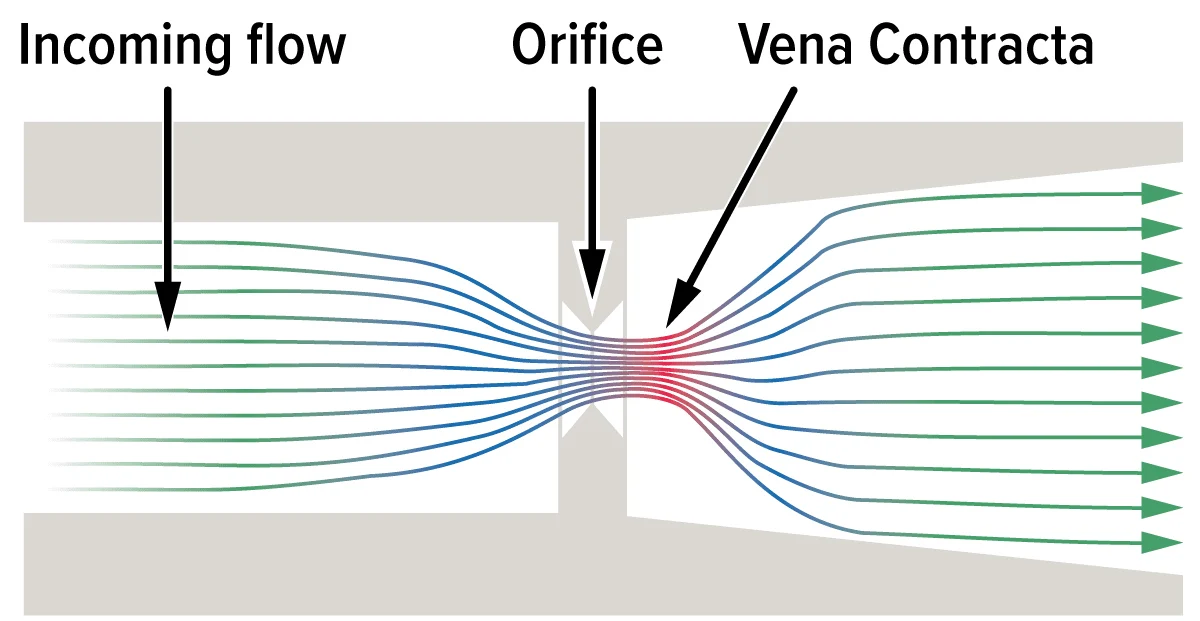
As flow approaches any restriction, such as an orifice or a valve, the outer flow channels, or those farthest away from the restriction, start to bend towards the inner flow channels, or those nearest to the restriction. As flow reaches to the restriction, the inner flow accelerates as a result of condensing flow from the outer flow channels.
Just after the restriction, the outer flow channels continue to bend into the inner flow channels, resulting in continued narrowing and acceleration of the flow. Eventually, flow begins to move back from the inner flow channels to fill out the outer flow channels, returning to normal flow. In other words, even though the flow path is again unrestricted and normal, the flow doesn’t instantly correct itself. Instead, it takes a little distance and time to spread out again.
Vena contracta
Due to fluid momentum, as fluid passes a restriction such as an orifice or valve, it continues to compress itself. Since this momentum takes some time and distance to change back around to start expanding, the fluid’s narrowest contraction point is just past the orifice or valve.
We refer to this narrowest flow point as the vena contracta, which means “narrow veins” in Latin. The term jetting is used to describe the phenomena of this unique, constricted flow pattern.