
Veloce Echelle Spectrograph Utilizes Closed-Volume Pressure Control
Summary
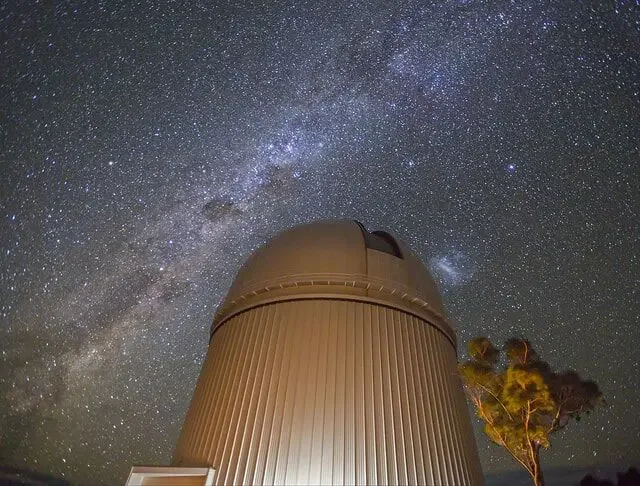
The Veloce is a fiber-fed échelle spectrograph designed to deliver high-precision radial velocity measurements for exoplanet detection at the Siding Spring Observatory. As with other high-resolution spectrographs using échelle grating, the instrument’s precision is highly dependent on the refractive index of the atmosphere surrounding its optical path. Maintaining stable pressure, temperature, and air composition is therefore essential over the multi-month observation periods required to characterize an exoplanet’s orbit.
Veloce is unique in its construction. Spatial and mechanical constraints led to researchers building a lightweight design that operates at positive pressure rather than relying on a conventional vacuum vessel. The optical bench is housed within the inner chamber of a dual-enclosure system designed to support active environmental regulation.
This article focuses on the pressure control system implemented within the internal enclosure and its role in maintaining stable atmospheric conditions over extended observing periods.
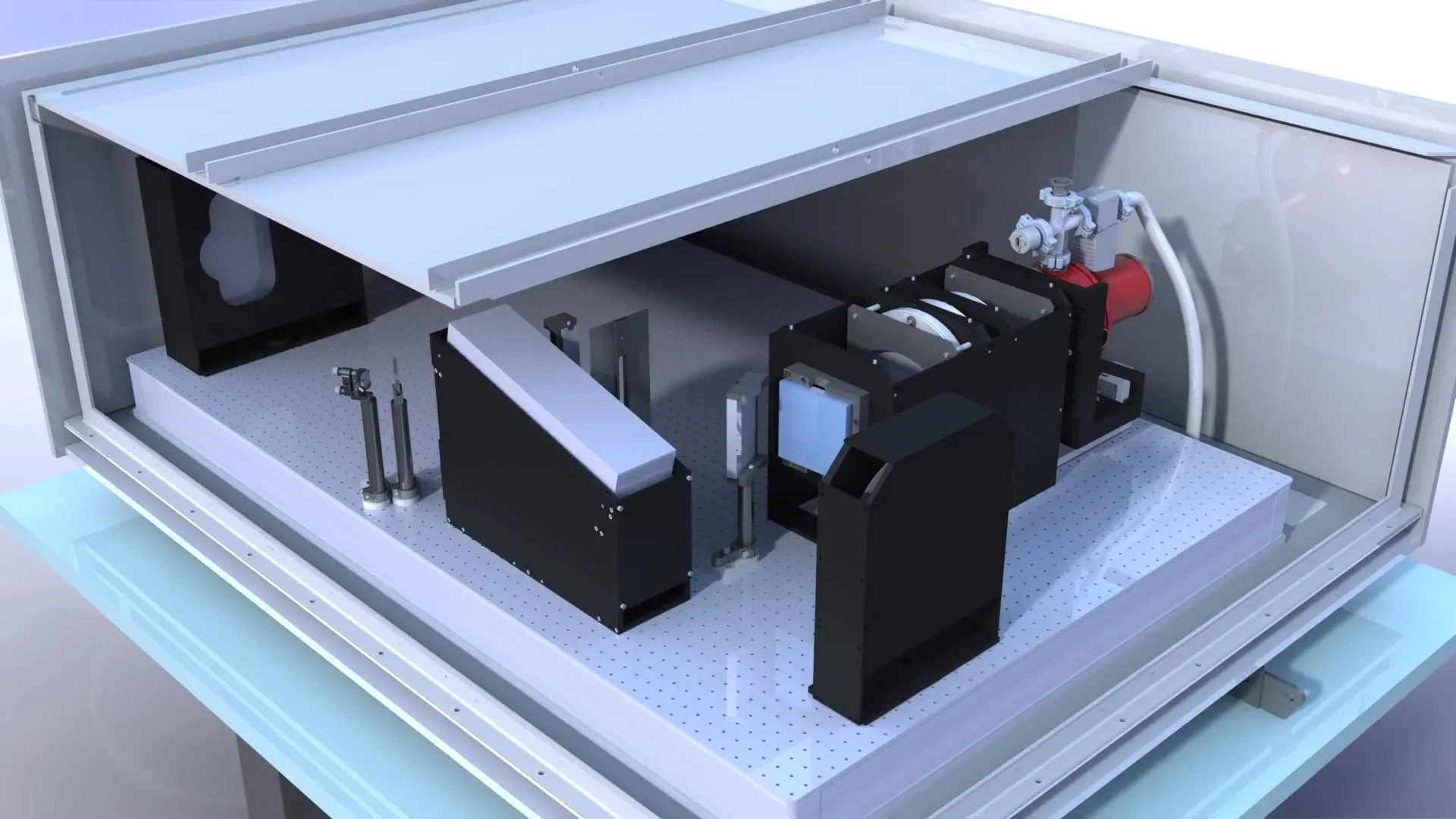 CAD rendering of the Veloce’s internal enclosure
 Challenge
Long-term air pressure stability
The primary challenges encountered were:
- Leak sensitivity
Pressure stability depended on minimizing air leakage through panel interfaces, service feedthroughs, and access points, while compensating for unavoidable small leaks that developed over long-term operation. - Maintaining positive pressure
The enclosure was operated at a constant positive pressure relative to ambient conditions. The pressure setpoint had to remain above the maximum expected atmospheric pressure on site, at all times. Pressure stability was specified at ±5 mbar, with a design goal of ±1 mbar. - Seasonal atmospheric variation
Long-term changes in ambient barometric pressure over the course of the year introduced slow but persistent disturbances that the pressure control system was required to accommodate. - Lightweight enclosure
The internal enclosure was intentionally lightweight and elastically deformed in response to differential pressure between the interior and the surrounding environment. Pressure fluctuations therefore translated into small mechanical motions that could affect optical stability if not properly controlled.
Veloce was designed to detect the minute radial-velocity signatures of orbiting exoplanets by measuring extremely small Doppler shifts in stellar spectra. At this level of sensitivity, even minor changes in pressure had the potential to degrade measurement precision, making reliable long-term pressure control a fundamental system requirement.
“Veloce was built primarily to detect stars that are ‘wobbling’ due to the gravitational tug of one or more orbiting planets. Veloce is based on a technique called Precision Radial Velocity Spectroscopy — we measure the spectral content of starlight and look for minuscule colour shifts (Doppler shifts) caused by the periodic motion of the star.
It is absolutely critical to control the measurement errors of the instrument, because the signal we are looking for is so small. We are looking for changes of 1/1500 pixels on our image detector, which is a physical distance of something like ten nanometers on the detector surface. This corresponds to a radial velocity measurement of around 1 m/s, meaning we can measure the speed of a star’s motion down to slow walking pace. This is sufficient to detect planets not too dissimilar to Earth, that may be in the so-called ‘habitable zone’ of the host star…”
— Dr. James Gilbert
Selection
Integrated pressure control system

When even minor deviations from the pressure setpoint were detected, the controller adjusted both inlet and outlet valves, allowing intake from a dry air source (−40°C dew point), or venting to atmosphere when needed. This bidirectional control suppressed disturbances within ~30 ms, limiting total pressure variation in the chamber to less than 0.3 mbar.
Because the environmental monitoring system was also watching temperature requirements at the 10 mK level, any variable heat load inside the enclosure posed a risk. As a result, the controller was mounted outside the chamber, with only tubing and a remote pressure sensor penetrating the enclosure, reducing the potential for thermal disturbances to couple into the instrument.
The PCD’s multiple communication methods, including 4 – 20 mA analog signals and common serial communication protocols such as Modbus RTU, provided flexibility in determining Veloce’s control structure. Additional control features, including a configurable deadband, allowed operators to define a narrow pressure range around the setpoint within which no valve action was taken. This reduced unnecessary valve activity and helped prevent control-induced pressure oscillations once steady-state conditions were reached.
The PCD was selected for its precise pressure regulation in dead-ended volumes, making it well suited to an application that had to hold a constant absolute pressure over many months.
“If the air pressure in the instrument changes, then the refractive index at the surface of the optics changes, and our signals are completely drowned out. We decided to shield the instrument from atmospheric pressure variations by keeping it at a fixed positive pressure at all times. We needed a stability of 5 mbar, with a goal of 1 mbar, in an 1800-litre volume with significant leaks.
We approached Alicat because we needed industrial-grade reliability as well as science-grade performance. Alicat rose to the challenge and modified one of their standard products to provide an affordable solution to our requirements. The instrument has been operating for several months already, and its internal pressure has not ventured beyond 0.3 mbar of our setpoint, which is fabulous…”
— Dr. James Gilbert
Outcomes
The environmental control strategy implemented for Veloce delivered stable pressure and temperature performance that met, and in several cases exceeded, the original design requirements. The pressure control system operated reliably over extended periods, maintaining stable internal conditions despite ongoing ambient barometric and thermal variation at the observatory site.
Pressure regulation within the internal enclosure remained stable throughout long-term operation. The pressure controller responded predictably to both slow seasonal changes and short-term disturbances, maintaining internal pressure within the specified stability limits. This level of control proved sufficient to suppress pressure-driven refractive-index variations and prevent measurable degradation of spectrograph performance.
While the lightweight, pressurized enclosure approach introduced several engineering challenges, none translated into significant operational limitations. The primary dependency identified was the continuous availability of facility compressed air. In practice, this reliance did not result in performance issues during normal operation, and short interruptions were considered manageable through the addition of a suitably sized buffer volume to compensate for minor enclosure leakage.
The positive-pressure enclosure implemented for Veloce proved to be an effective alternative to vacuum-based designs, achieving the necessary environmental stability within mechanical, spatial, and cost limitations. Precise pressure control using commercially available Alicat Scientific instrumentation enabled high-precision radial-velocity spectroscopy without the complexity of a vacuum system.
“Veloce is now fully commissioned and has already observed its first planetary systems. Initially, we are looking at known candidates found by NASA’s Transiting Exoplanet Survey Satellite (TESS). Veloce is currently the best instrument in the world for some of these targets, and may be the first to confirm the existence and accurately measure the mass of planets we previously didn’t know existed.”
— Dr. James Gilbert
References
- Gilbert, J., Bergmann, C., Bloxham, G., Boz, R., Brookfield, R., Carkic, T., Carter, B., Case, S., Churilov, V., Ellis, M., Gausachs, G., Gers, L., Gray, D., Herrald, N., Ireland, M., Jones, D., Kripak, Y., Lawrence, J., O’Brien, E., … Zhelem, R. (2018). Veloce Rosso: Australia’s new precision radial velocity spectrograph. In C. J. Evans, L. Simard, & H. Takami (Eds.), Ground-based and Airborne Instrumentation for Astronomy VII (pp. 1-18). Article 107020Y (Proceedings of SPIE; Vol. 10702). SPIE. https://doi.org/10.1117/12.2312399