Flow & Pressure Control in Hazardous-Area GC & Analyzer Systems
Introduction and context:
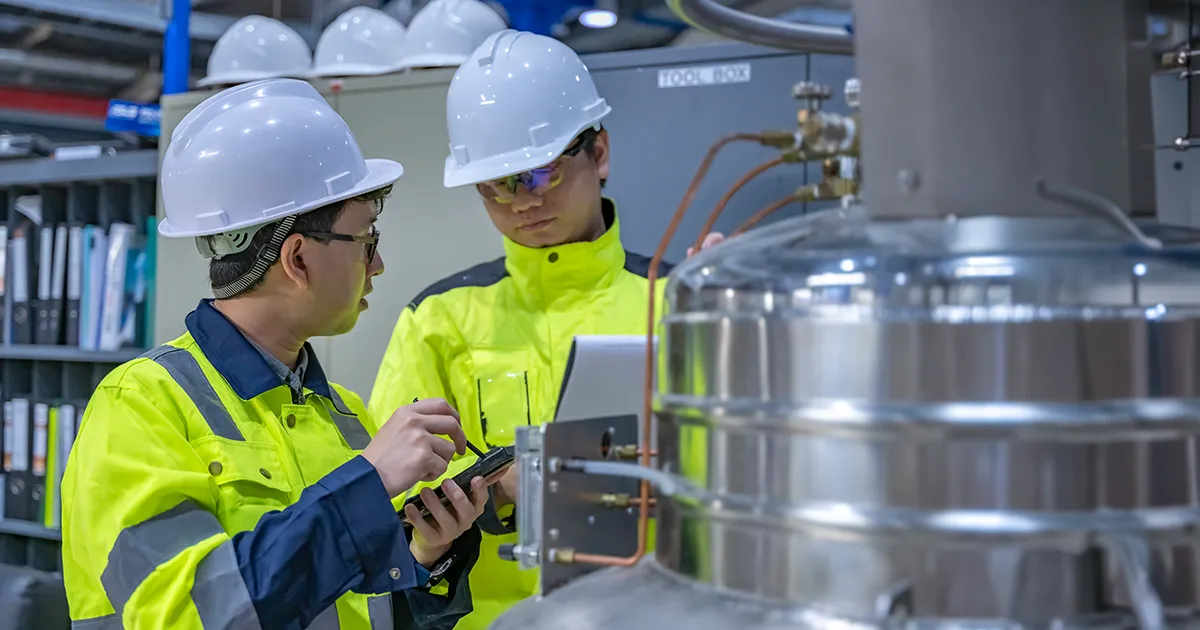
In oil refining and petrochemical processing environments, online gas chromatography (GC) is one of the most critical analytical tools used for continuous process optimization, product quality, and safety assurance.
GCs are used to analyze the composition of several petrochemical samples and products in the oil and gas industry, such as:
- Sulfur content and vapor pressure for regulatory compliance
- RON/CETANE values for fuel performance indicators
- Hydrocarbon compositions for process optimization
- Toxic and hazardous compound detection (H2S, BTX, and flammables)
Unlike lab-based analysis, these GCs are integrated directly into the process environment, where they must operate continuously and reliably under demanding conditions. Stable and precise control of gas flow and pressure directly determines accuracy of the analysis, repeatability, and reliability of the system.
However, when these systems are deployed in hazardous environments, the types of instrumentation available are limited.
Hazardous area constraints:
These applications are deployed in ATEX Zone 0/ Zone 1, or Class I Division 1 hazardous locations. These zones indicate a continuous or frequent presence of explosive gases, and strict requirements for ignition prevention.
Instrumentation installed in such areas must be intrinsically safe, hence limiting the electrical and thermal energy available to ignite flammable materials. Alternatively, explosion-proof enclosures or special purge/pressurization systems must be implemented. These will typically increase overall cost, footprint, system complexity, and maintenance.
Legacy Approach
Mechanical control systems
In the past, to comply with the safety standards, customers relied on full mechanical control which typically consisted of armored rotameters, analog gauges, and needle valves. The simplicity of mechanical instrumentation reduced challenges involved with meeting safety requirements.
With the implementation of mechanical solutions, several limitations were observed in the field.
Performance instability
- Mechanical regulators were known to drift over time
- Tight control of flow and pressure were limited
- Instability of mechanical components led to unstable GC measurements
- Barometric pressure impacts system behavior
Manual Interventions
- Operators are physically required to enter hazardous zones for adjustments to regulators and valves
- Increased safety risk, and higher labor burdens
Lack of Visibility
- Continuous monitoring was not available
- Lack of data logging
- Preventative maintenance was not available due to lack of real-time diagnostics
System Complexity
- Higher component count
- Multiple leak paths
- Increased maintenance efforts
In the oil and gas industry, the current tradeoff can be summarized as follows: Safe (mechanical) systems sacrifice performance and visibility, while high-performance electronic control hasn’t been deployable due to safety restrictions.
Alicat intrinsically safe solution:
Critical deployment points include the following:
- Sample Injection
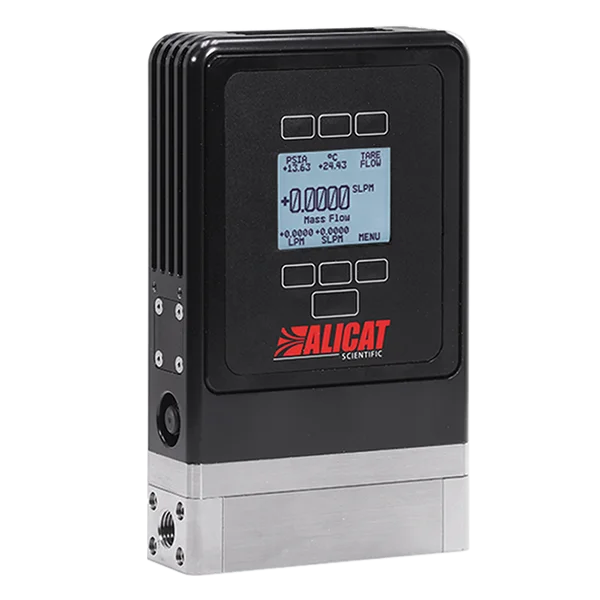
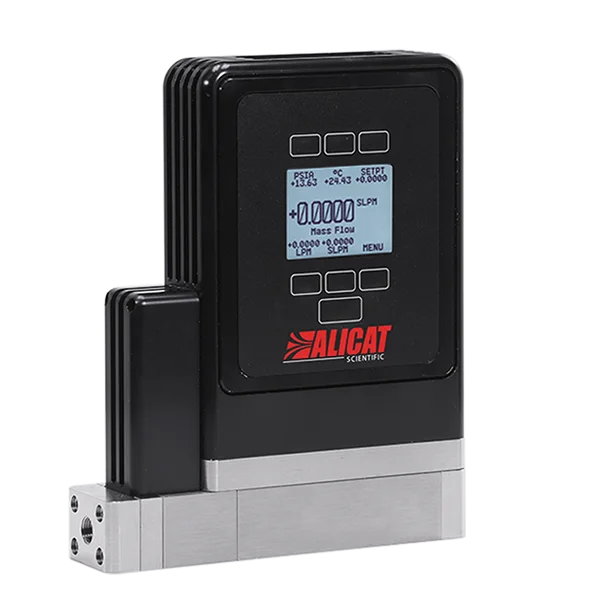
- IS-Max MFC can regulate both pressure while measuring flow, for precise sample or calibration gas delivery to the GC
- Totalizer function can track sample usage over longer sample cycles
- Absolute pressure sensor eliminates uncertainty caused by barometric pressure fluctuations
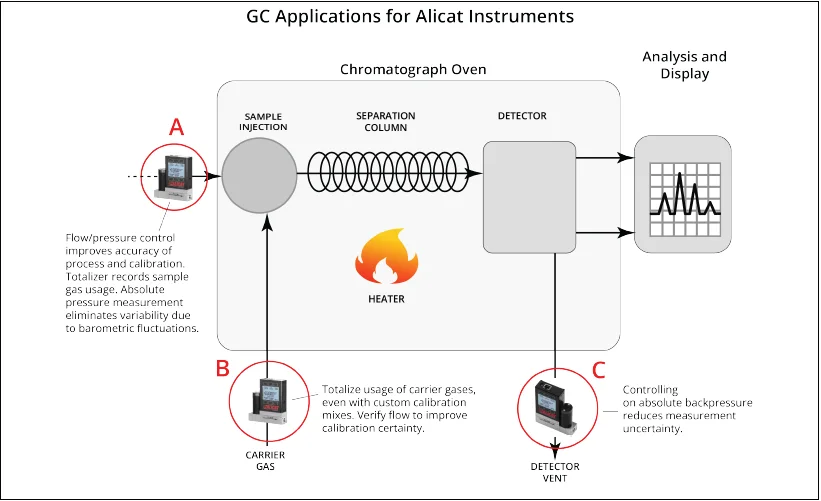
- Carrier Gas
- IS-Max controller or meter totalizes carrier gas usage, even with custom calibration mixes
- Flow verification improves the calibration certainty and repeatability
- Backpressure Control
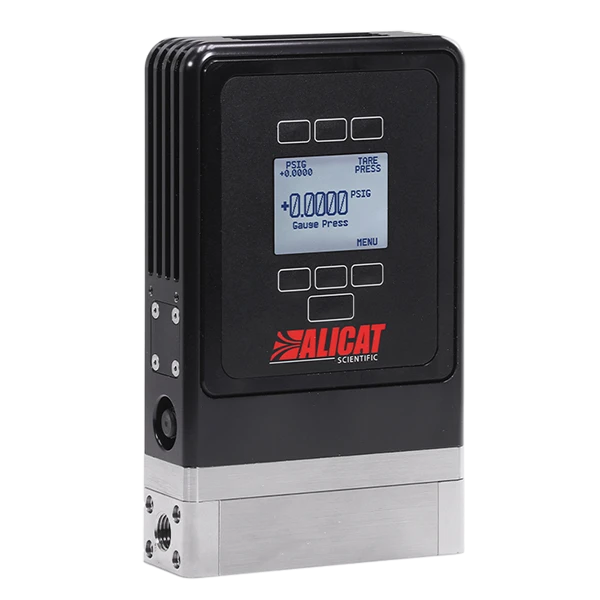
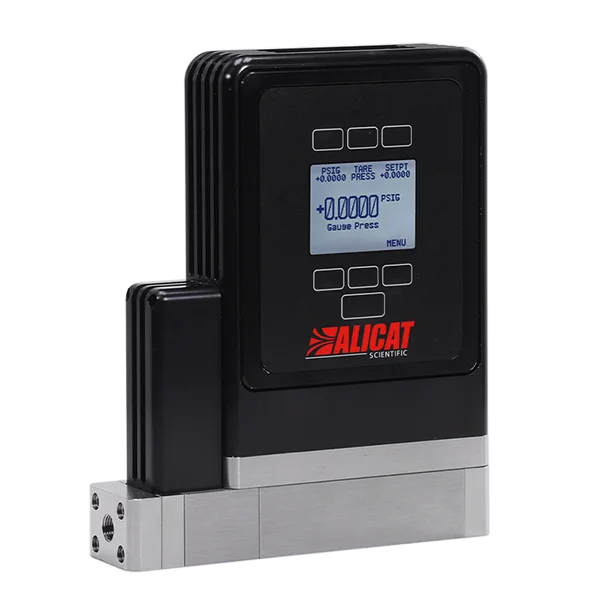
- IS-Pro pressure controllers can control back pressure on the detector vent outlets. This stabilizes the detector’s performance
- Instead of a dedicated pressure controller, IS-Max flow controllers can control the backpressure and measure the mass flow rate
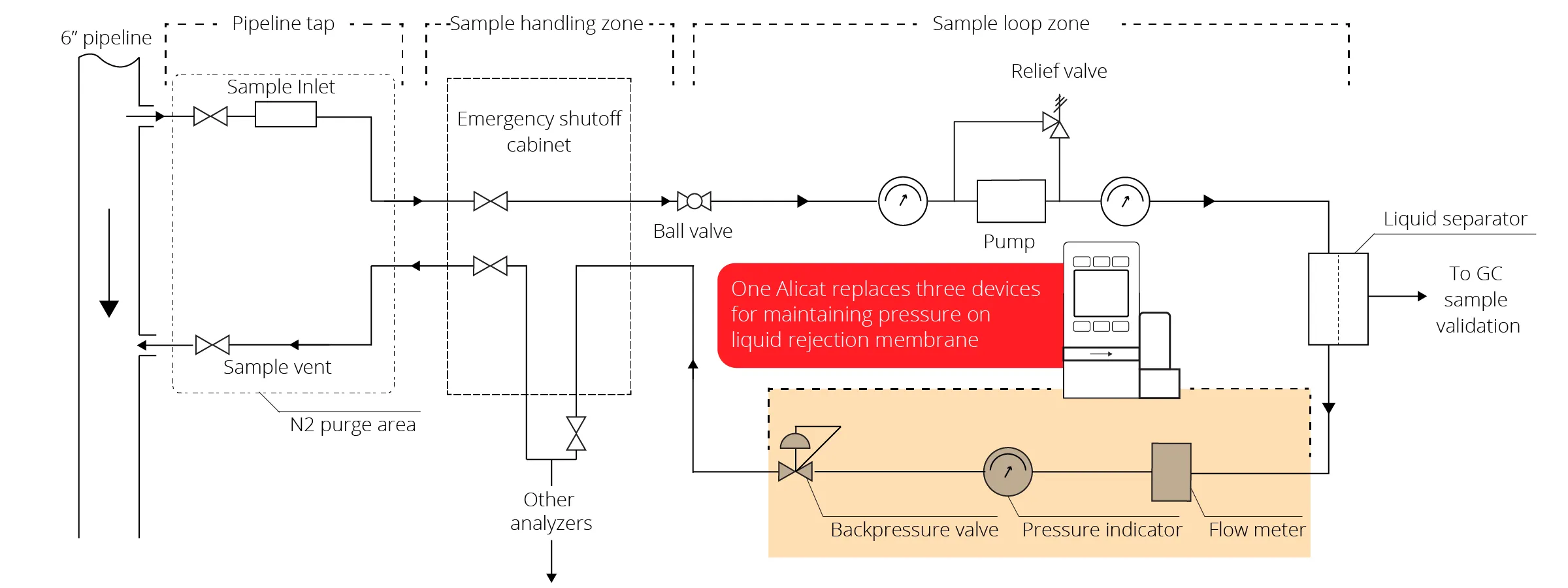
The strength of Alicat instrumentation here is the ability to replace multiple discrete mechanical components with a singular, intrinsically safe device.
Despite variations in the operating conditions within the system, an Alicat instrument can correct automatically for variability and constantly output stable flow and pressure, eliminating drifts over time.
Digital communication allows for remote setpoint adjustments, continuous data streaming, and data logging for analysis.
In hazardous GC systems, analyzer engineers have traditionally accepted reduced performance as the cost of safety. Intrinsically safe electronic control removes that compromise.